
Why Your Business Isn’t Ranking on Google (And How to Fix It)
Buried on page two? You’re not alone. Here are the six most common reasons businesses fail to rank on Google — and the practical fixes that will change that.
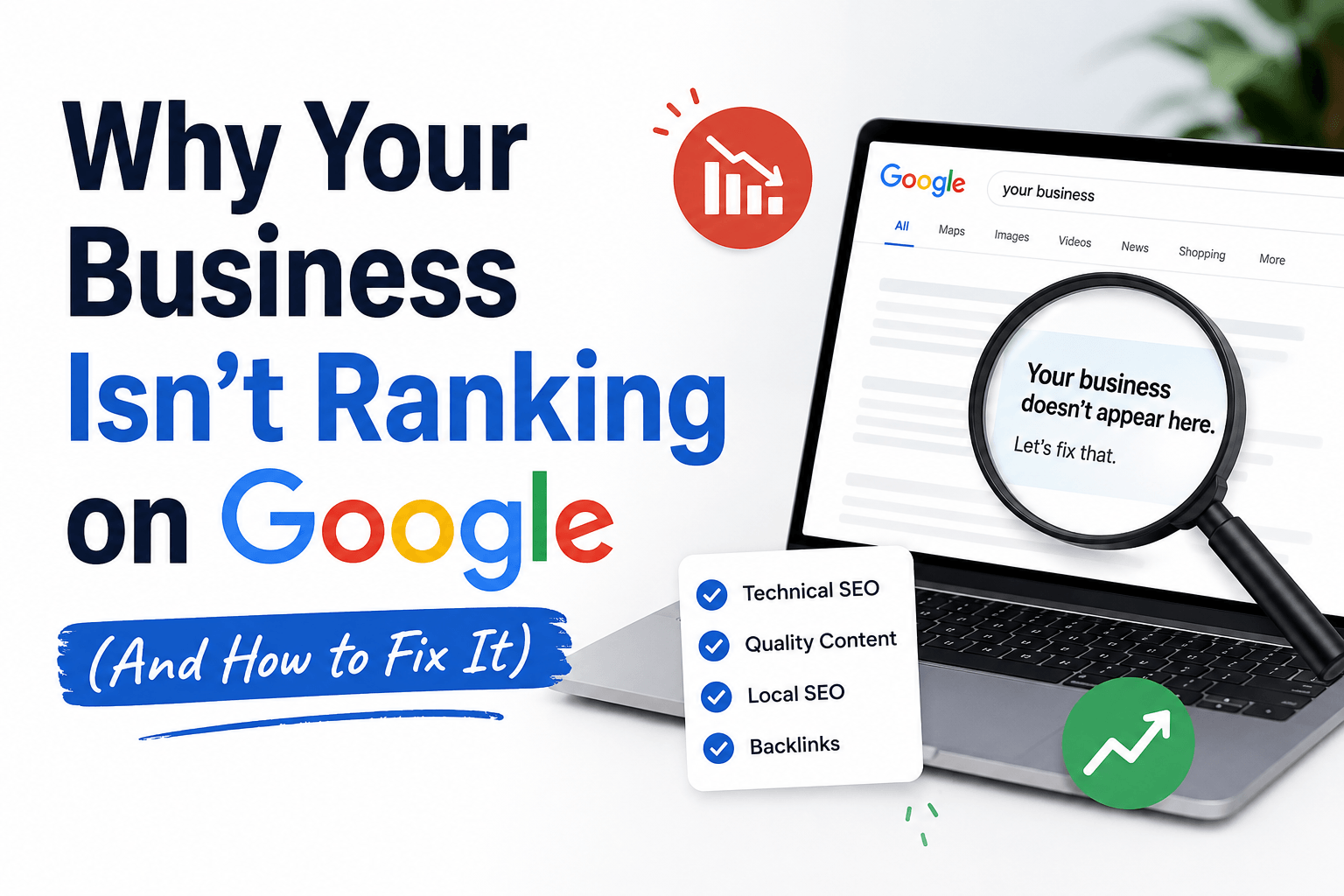
If you’ve ever searched for your own business on Google and found yourself buried on page two, three, or beyond, you’re not alone. Millions of businesses invest time and money into their websites, only to find that Google simply isn’t sending them traffic. The good news? In most cases, the reasons are fixable — and they’re more common than you might think.
Here are the most frequent reasons businesses struggle to rank, and what you can do about each one.
1. Your Website Has Weak or No On-Page SEO
On-page SEO refers to the signals on your actual web pages that help Google understand what your content is about. If your pages are missing optimised title tags, meta descriptions, header tags (H1, H2, H3), and keyword-rich content, Google has very little to work with.
The fix: Audit every key page on your site. Make sure each page targets a specific keyword, uses that keyword naturally in the title, headers, and body content, and has a compelling meta description that encourages clicks.
2. You’re Targeting Keywords That Are Too Competitive
Many businesses make the mistake of going after broad, highly competitive keywords from day one — think “SEO agency” or “digital marketing.” These terms are dominated by major brands with enormous budgets and years of authority built up.
The fix: Focus on long-tail keywords — more specific phrases that reflect exactly what your customers are searching for, such as “SEO agency for professional services firms” or “managed SEO services for SaaS companies.” These have lower competition and often convert better because they attract searchers with clear intent.
3. You Don’t Have Enough Quality Backlinks
Backlinks — links from other websites pointing to yours — are one of Google’s most important ranking signals. They act as votes of confidence. If your site has few or no quality backlinks, Google is less likely to trust it enough to rank it highly.
The fix: Build a backlink strategy. This includes earning links through great content, reaching out to relevant industry websites, getting listed in directories, and forming genuine partnerships. Quality always beats quantity — one link from a reputable source is worth far more than dozens from low-quality sites. NBound’s ethical backlink building service can help you get started.
4. Your Website Is Slow or Doesn’t Work Well on Mobile
Google uses Core Web Vitals as a ranking factor, which means page speed, visual stability, and interactivity all matter. If your site takes more than a few seconds to load — especially on mobile — you’re likely being penalised in the rankings.
The fix: Run your site through Google’s PageSpeed Insights tool to identify performance issues. Common culprits include uncompressed images, slow hosting, and excessive plugins. Ensure your site is fully responsive and delivers a smooth experience on all devices.
5. Your Content Doesn’t Match Search Intent
Even well-optimised content can fail to rank if it doesn’t match what the searcher actually wants. Google has become very good at understanding intent — whether someone is looking to buy, learn, compare, or find a specific website.
The fix: Before writing any piece of content, search your target keyword yourself and study the top-ranking results. What format do they use? Are they blog posts, product pages, or guides? What questions do they answer? Your content should meet the same intent — and ideally, do it better.
6. You Haven’t Been Consistent
SEO is not a one-time task — it’s an ongoing process. Businesses that publish content once and then go quiet, or optimise their site and then neglect it, rarely see sustained results. Google rewards websites that are actively maintained and regularly updated.
The fix: Create a content calendar and stick to it. Whether it’s one blog post per week or per month, consistency signals to Google that your site is alive and authoritative. Regular technical audits are equally important to catch and fix any issues before they hurt your rankings.
Ready to Start Ranking?
Improving your Google rankings doesn’t have to feel overwhelming. By addressing these six areas — on-page SEO, keyword targeting, backlinks, site speed, search intent, and consistency — you’ll be well on your way to building a stronger, more visible online presence.
If you’d like expert help getting there faster, NBound’s managed SEO services are designed to take care of all of this for you — so you can focus on running your business while we focus on growing it.
Read Next

A Beginner’s Guide to Technical SEO
Technical SEO is the foundation every successful website is built on. This beginner’s guide breaks down crawling, indexing, site speed, and the fixes that help Google rank your pages.

Generative Engine Optimization (GEO): The Complete 2026 Guide
AI now answers questions instead of listing links. Generative Engine Optimization (GEO) is how you get your brand cited inside those answers. Here’s what works in 2026, backed by the data.

What is local SEO?
Learn what local SEO is, why it’s vital for local businesses, and get 5 tips to improve your local SEO to get found by your customers.