
Generative Engine Optimization (GEO): The Complete 2026 Guide
AI now answers questions rather than listing links. GEO is how you get your brand cited inside those answers. Here’s what works in 2026, backed by the data.
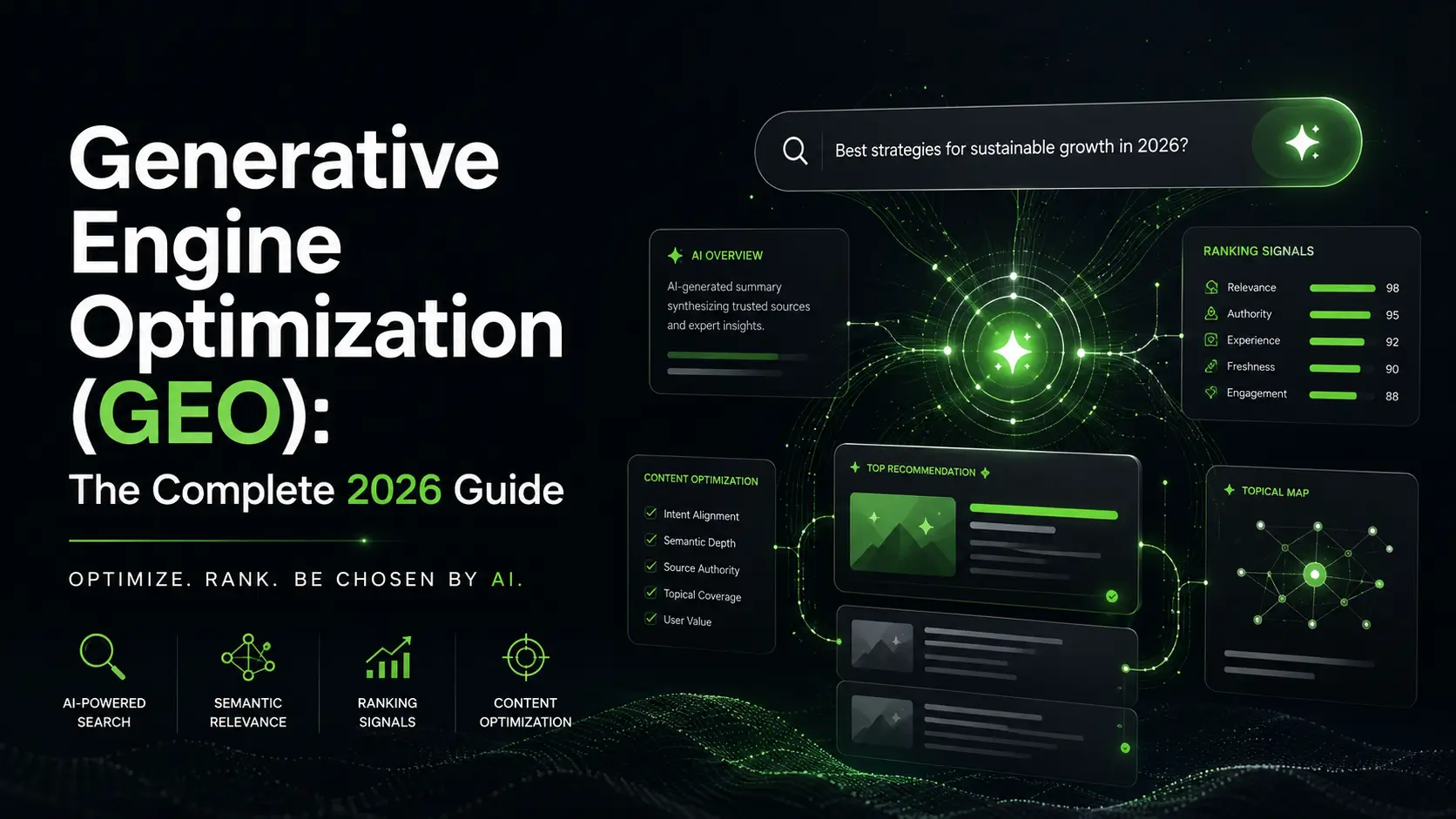
Ask ChatGPT for the best project management tool for a small agency and it won’t hand you ten blue links. It gives you a short answer, names two or three products, and moves on. Whether your brand turns up in that answer has quietly become one of the most valuable questions in marketing.
That shift has a name. Generative Engine Optimization, or GEO, is the work of shaping your content so AI systems quote it when they answer a question. Traditional SEO aimed to rank your page in a list. GEO aims to get your words used inside the answer the AI writes. The two overlap, but they reward different things, and the gap is widening fast.
This guide covers what GEO is, why it matters in 2026, how AI engines decide what to cite, and the specific tactics that move the needle. Most of the advice rests on measured results rather than opinion, and every figure below is dated and attributed.
What Is Generative Engine Optimization (GEO)?
Generative Engine Optimization is the practice of structuring and writing content so AI search systems, such as ChatGPT, Google AI Overviews, Perplexity, Gemini and Copilot, are more likely to cite, summarise or reference it in the answers they generate. Instead of competing for a ranked position, you compete for inclusion in a synthesised response.
The term comes from a 2024 research paper, GEO: Generative Engine Optimization, written by researchers at Princeton, Georgia Tech, the Allen Institute for AI and IIT Delhi. They built a benchmark of roughly 10,000 queries, tested nine content techniques, and found that the right changes lifted a source’s visibility in AI answers by up to 40%. That paper turned GEO from a hunch into something you can measure.
GEO vs SEO: What Changed
GEO doesn’t throw out SEO. It sits on top of it. The crawling, indexing and authority signals you already work on still matter, because AI engines often draw from the same search index. What changes is the goal at the end of the pipe.
| Question | Traditional SEO | GEO |
|---|---|---|
| What wins? | A high-ranking link | A citation inside the AI answer |
| Who sees it? | Searchers scanning results | Anyone reading a generated summary |
| Unit of value | The click | The mention |
| What helps most | Keywords, links, page speed | Clear answers, stats, quotes, citations |
If your pages already struggle to appear on Google, fix that foundation first. Our guide on why your business isn’t ranking on Google walks through the usual culprits. GEO works best when the basics are in place.
Why GEO Matters Now
The audience has moved, and the numbers are no longer small. OpenAI reported that ChatGPT passed 900 million weekly active users in February 2026, more than double a year earlier, and the app crossed one billion monthly users by June 2026. Google’s AI Overviews, the summaries that sit above the regular results, reach about two billion people a month across more than 200 countries.
More important for your traffic is what those summaries do to clicks. A Pew Research Center study of 900 US adults in March 2025 found that people clicked a regular search result 8% of the time when an AI summary appeared, against 15% when it didn’t. Links inside the summary itself were clicked on 1% of visits. When the AI answers the question on the page, far fewer people travel to the source.
Buyer behaviour is shifting with it. By 2026, about 37% of consumers say they start a search with an AI tool rather than a search engine, according to an Eight Oh Two study, while Bain & Company found 56% still mostly begin with a search engine against 16% who start with a chatbot. The default hasn’t flipped yet, but a real slice of research and product comparison now happens inside AI answers. If your brand is missing from them, a competitor is filling the gap.
How AI Engines Decide What to Cite
A generative engine reads a query, gathers candidate sources, and writes a single answer that blends them. To get used, your content has to be easy to lift and easy to trust. Three things help most.
First, clarity. The engine looks for a passage that answers the question directly, so a buried or hedged answer gets skipped. Second, evidence. The Princeton team found that adding citations, quotations from named sources, and concrete statistics produced the biggest visibility gains, with some of those methods lifting a mid-ranked page’s visibility by more than 100%. Third, outside validation. Muck Rack reported in May 2026 that 84% of AI citations come from earned media rather than a brand’s own pages, which means coverage on third-party sites carries real weight.
How to Optimize Your Content for GEO
These are the tactics that consistently improve whether AI engines quote you. None of them require gaming the system. They reward content that is useful and easy to verify.
1. Answer the question in the first two sentences
Lead with the answer, then explain. If someone asks “what is a good email open rate,” your opening line should state a number and a benchmark before any throat-clearing. AI engines extract the cleanest, earliest answer they can find, so put it where they will see it. Long preambles cost you the citation.
2. Add statistics, quotes, and citations
This is the single highest-return change in the GEO research. Replace vague claims with specific, sourced figures. “Email marketing performs well” tells an AI nothing. “Email marketing returns about $36 for every $1 spent, according to the Data & Marketing Association” gives it a quotable fact with a source attached. Quote named experts where you can, and link to the primary research behind your numbers.
3. Use clear structure and schema markup
Headings, short paragraphs, tables and lists make content easier for a model to parse and reassemble. Structured data does the same job in the background by telling search systems what each part of your page means. Adding the right schema markup, such as FAQ, Article and Organization types, helps engines understand and reuse your content. This very post carries FAQ schema for that reason.
4. Build topic clusters, not orphan pages
AI engines favour sources that show depth on a subject. A single thin post rarely becomes a trusted reference. A pillar page supported by focused articles, all linked together, signals genuine authority. If you need to cover a large set of related queries at scale, programmatic SEO can help you produce that depth without writing every page by hand.
5. Earn third-party mentions
Since most AI citations trace back to earned media, getting referenced by reputable publications, directories and review sites does double duty. It builds the backlinks SEO has always valued, and it places your brand in the exact sources AI engines pull from when they cite. Digital PR and expert commentary are worth more in a GEO world than they were two years ago.
6. Match the question format
People ask AI tools full questions, so write content that mirrors them. Question-style headings and concise answers map neatly onto how engines retrieve information, and they overlap heavily with the work behind featured snippets. A page built to win a snippet is already most of the way to being quoted by an AI.
How to Measure GEO Results
You can’t improve what you don’t track, and GEO measurement is younger and messier than SEO reporting. Start by running your priority queries through ChatGPT, Perplexity, Gemini and Google AI Overviews on a regular schedule, and record whether your brand appears, how it’s described, and which page gets cited. A simple monthly log will show movement before any tool does.
Watch accuracy too. AI systems sometimes describe brands and products incorrectly, so check how you’re being represented and correct the underlying content when it’s wrong. These prompts for fact-checking AI content are a practical way to catch errors before they spread into more answers.
Common GEO Mistakes to Avoid
Three patterns hold brands back. Burying the answer under an introduction, which costs you the extraction. Making claims with no sources, which gives an AI nothing to trust or quote. And treating GEO as separate from SEO, when the two share an index and a foundation. Fix the fundamentals, write clearly, and back every claim with evidence.
Frequently Asked Questions
What is generative engine optimization (GEO)?
GEO is the practice of structuring content so AI search systems like ChatGPT, Google AI Overviews and Perplexity cite or summarise it in their answers. Rather than competing for a ranked link, you optimise to be included in the AI’s generated response through clear answers, sourced facts and structured formatting.
How is GEO different from SEO?
SEO works to rank your page in a list of search results. GEO works to get your content quoted inside an AI-generated answer. SEO rewards keywords, links and technical health. GEO rewards direct answers, statistics, quotations and citations that make content easy for a model to lift and trust.
Does GEO replace SEO?
No. GEO builds on SEO rather than replacing it. AI engines often pull from the same search index, so crawlability, authority and quality still matter. The practical move in 2026 is to keep doing solid SEO and layer GEO tactics on top so your content performs in both classic results and AI answers.
How do I get my content cited by ChatGPT?
Answer the question early and plainly, support every claim with specific statistics and named sources, and structure the page with clear headings and schema markup. Earning mentions on reputable third-party sites also helps, since most AI citations come from earned media rather than a brand’s own pages.
Can you measure GEO results?
Yes, though the methods are still maturing. Run your target questions through the major AI tools on a fixed schedule and track whether your brand appears, how it’s described, and which page is cited. Dedicated AI-visibility tools now exist, but a consistent manual log already reveals progress.
Getting Started With GEO
GEO doesn’t ask you to abandon everything you know about search. It asks you to write clearer answers, prove your claims, structure your pages well, and earn outside mentions. Do that, and you’ll show up whether someone types a query into Google or asks a chatbot.
If you’d rather have a team handle the work, NBound’s managed SEO services cover both the SEO foundation and the GEO tactics that get your brand cited in AI answers, so you can focus on running the business while we focus on growing your visibility.
Read Next
A Beginner’s Guide to Technical SEO
Technical SEO is the foundation every successful website is built on. This beginner’s guide breaks down crawling, indexing, site speed, and the fixes that help Google rank your pages.

Why Your Business Isn’t Ranking on Google (And How to Fix It)
Struggling to appear on Google’s first page? Discover the most common SEO mistakes holding your business back — and the practical fixes that will help you climb the rankings.

What is local SEO?
Learn what local SEO is, why it’s vital for local businesses, and get 5 tips to improve your local SEO to get found by your customers.