
NBOUND RESEARCH · AI WRITING TOOLS
The 5 Best Free AI Checkers in 2026
By James McAvoy, NBound · Last updated October 29, 2026
In short: the best free AI checkers in 2026 are the Content Shape Checker for editing your own drafts, Copyleaks for long documents and non-English text, ZeroGPT for a fast verdict with no account, Sapling for short copy and QuillBot for a quick second opinion. All five can be used without paying.
They split into two kinds of free AI content checker. Detectors such as Copyleaks, ZeroGPT, Sapling and QuillBot estimate how likely it is that a model wrote a text, and give you a percentage. A structure checker such as the Content Shape Checker shows you which sentences make a draft read machine-made and how to fix each one. Editing your own content before it goes live? Start with structure. Screening someone else’s work? Use a detector, and never treat its score as proof.
How we picked these
We looked at what each tool gives you without paying: how much text one check covers, whether the result points at specific sentences, which languages it handles, and what happens to the text you paste in. We read each tool’s own pages on October 29, 2026.
The same day, we ran two samples through each tool. The results are below. Two samples can’t measure accuracy, so any accuracy figure in this article is the vendor’s own claim and is labeled that way. Free limits change often. Check the tool’s page before you build a workflow around it.
Most of the detectors here warn against leaning on them too hard. Sapling says no detector, its own included, should be used as a standalone check. QuillBot’s results panel tells you never to rely on AI detection alone for decisions that could affect someone’s career or academic standing. Take them at their word.
Disclosure: the Content Shape Checker is published by the AI Visibility Census, a project NBound works with.
| Tool | Type | Free allowance | What you get back |
|---|---|---|---|
| Content Shape Checker | Structure checker | Up to 3,000 words per check, no signup, no paid tier | Every flagged sentence, the reason and a fix |
| Copyleaks | Detector | Up to 25,000 characters per scan | AI score, human and AI sections marked |
| ZeroGPT | Detector | Up to 15,000 characters per check, no account | AI percentage and a one-line verdict |
| Sapling | Detector | First 2,000 characters per check | Overall score plus a score per sentence |
| QuillBot | Detector | 1,200-word paste box, 5 scans a day | AI score from 0% to 100% |
What happened when we ran them
On October 29, 2026 we ran the same two samples through the free web version of each tool, without signing in.
The first was a 337-word blog post on content strategy that we generated for the test: five headed sections, written in the default style a model produces when nobody edits it. The second was 552 words from a March 2018 post on the FTC’s Business Blog, written by FTC staff more than four years before ChatGPT launched. FTC website content is in the public domain, which is why we could use it.
| Tool | AI-generated draft (337 words) | Human FTC post (552 words) |
|---|---|---|
| Content Shape Checker | Failed 4 of 4 shape checks; AI-style signals High | Passed all 4 shape checks; AI-style signals Low |
| Copyleaks | 100% AI | 0% AI |
| ZeroGPT | 100% AI | 0% AI (“Your Text is Human written”) |
| Sapling | 100.0% AI (first 2,000 characters) | 0.0% AI (first 2,000 characters) |
| QuillBot | 100% AI-generated | 0% AI-generated, 100% human-written |
Every detector got both samples right. That is the easy case: raw model output against a human post full of jokes and named specifics. It tells you nothing about lightly edited AI text or formal human writing, which is where Sapling and QuillBot both warn that detectors can get it wrong.
The detectors differed more in what they showed for free. Copyleaks counted 39 AI phrases in the draft but kept the list locked inside its AI Logic feature, which its site lists with the paid plans. QuillBot highlighted the generated draft, labeled its first highlighted passage as overly polished and generic, and named “digital landscape” as an AI phrase. Sapling gave a single percentage, with sentence scores one click away, and it only read the first 2,000 characters of each sample. ZeroGPT led with a percentage and a one-line verdict.
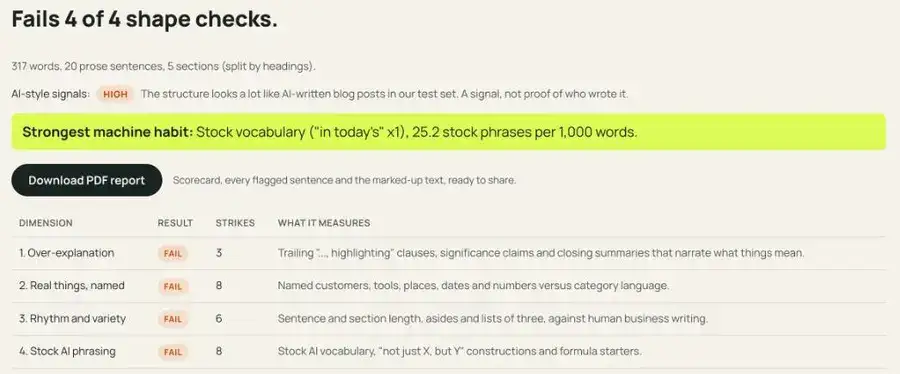
The Content Shape Checker failed the generated draft on all four checks and gave it a High AI-style reading. It named stock vocabulary as the strongest habit, at 25.2 stock phrases per 1,000 words, and its rhythm check found sentences that barely varied: a length spread of 5.3 words against a human average of 8.7, and not one sentence of 30 words or more. It labeled the draft’s opening line a warm-up rather than an answer. The FTC post passed all four checks, got a Low AI-style reading and an answer-first label on its opening line, and had three claims to verify, each with a source nearby.
The Content Shape Checker was updated while we were testing. An earlier version failed the FTC post on one check, because the post has no headings and 43% of its paragraphs opened the same way. Version 1.5 no longer scores repeated section openers, and the FTC post passed. The table shows the version 1.5 results.
We originally included GPTZero. On our second scan it asked us to create an account before showing the result, so we replaced it with ZeroGPT, which ran both samples without one.
1. Content Shape Checker
Best free AI checker for editing your own drafts before they ship.
Most AI checkers give you one number. The Content Shape Checker gives you editing notes instead: which sentences make a draft read machine-made, why, and what to change. It looks at how the piece is built as well as the stock phrases it leans on.
It runs four scored checks. Over-explanation flags sentences that tell you what the text has just shown, such as a summary that closes a section. Real things, named counts customers, tools, figures and places against category language like “organizations of all sizes”. Rhythm and variety measures how much sentence and paragraph length vary, how many sentences run to 30 words or more, and how often asides and lists of three turn up. Stock AI phrasing counts the words and constructions listed in Wikipedia’s guide to signs of AI writing, such as “landscape”, “leverage” and “not just X, but Y”. One or two hits never fail a piece; a fail needs at least three.
Two more sections sit outside the score. Claims to verify lists every statistic, study, superlative, quote and date in the draft and flags statistics and research claims with no source nearby; it doesn’t judge whether they’re true. AI-style signals gives a Low, Medium or High reading from a small model trained on eight structural features. The model was trained on 96 texts. On unseen texts, a High reading caught 18 of 26 AI texts while flagging 2 of 48 human ones. Counting Medium and High together, it caught 23 of 26 AI texts but also flagged 9 of 48 human ones. Those AI test texts all came from Claude models, so drafts from other tools may score differently.
The report quotes every flagged sentence with a suggested fix and names the one habit doing the most damage, which is usually the place to start. You can copy the whole report as Markdown and drop it into a ticket or a freelancer brief, or download it as a PDF. It also scores your opening sentence separately, labeling it answer-first or a warm-up, so you can see whether the page answers the question up front.
The analysis runs in your browser, so nothing you paste is uploaded or stored. There is no signup, no paid tier and no limit on how many drafts you check, at up to 3,000 words each. Paste text or upload a .docx, .md, .txt or .html file. PDFs aren’t accepted, because text pulled from a PDF loses the headings the section checks rely on.
The method is adapted from StoryScope, an April 2026 preprint from researchers at the University of Maryland and Google DeepMind. Using structure alone, the authors separated human from AI stories at 93.2% macro-F1 across 61,608 stories.
That study was on fiction, so for version 1.5 the publisher tested every rule on 1,952 business, news and essay documents, set the thresholds on part of the set and reported results on 966 documents the thresholds never saw. On held-out business writing, two or more checks failed on 31% of AI texts and 2% of human ones. The publisher reports an average of 0.9 failed checks per AI text against 0.1 per human text; the previous version scored 0.6 against 0.5, which it calls barely better than chance. Per check, rhythm and variety failed 50% of AI texts and 6% of human ones, real things named 27% against 4%, and stock AI phrasing 15% against 0%.
The limits are stated plainly on the tool’s own page. Its AI business texts all came from Claude, and its GPT samples date from 2023, so drafts from other current models are less tested. Over-explanation catches 2023-era GPT habits far more often than current Claude ones, so a pass on that check is weak evidence. Rhythm can’t fail a piece with fewer than 20 sentences, and student essays fail rhythm and phrasing more often than business writing does. Asked whether it detects AI, the tool’s own answer starts with “Partly”: it never proves who wrote a piece, and 2% of human business texts still failed two or more checks. It needs at least 80 words and works best between 300 and 1,500; the AI-style reading needs 300.
Why it’s first: it is the only tool on this list that tells you what to change, and it does the analysis in your browser rather than on a server. For a content or SEO team about to publish, that is the job.
2. Copyleaks
Best free AI detector for long documents and non-English content.
Copyleaks has the biggest single free scan of the detectors here: up to 25,000 characters, enough for a long blog post in one pass. A free account adds monthly credits on top. It supports more than 30 languages and marks human and AI sections separately when a document mixes the two.
Its AI Logic feature, which explains why a passage was flagged, is listed with the paid Personal and Pro plans. Copyleaks claims over 99% accuracy and a 0.03% false positive rate; those are its own figures. One detail worth knowing if your writers use Grammarly: Copyleaks says Grammarly’s AI rewriting features may trigger detection, while basic spelling and grammar fixes typically don’t.
3. ZeroGPT
Best free AI detector for a fast verdict without an account.
ZeroGPT’s free check takes up to 15,000 characters at a time, enough for most blog posts, and in our test it ran both samples without asking us to sign up. Upgrading raises the limit to 350,000 characters.
Its result leads with a percentage and a one-line verdict (“Your Text is AI/GPT Generated” or “Your Text is Human written”). ZeroGPT says it highlights every sentence it judges AI-written. Treat it as a fast yes-or-no check, and use the Content Shape Checker when you need to know what to change.
4. Sapling
Best free AI detector for short copy.
Sapling’s free check covers the first 2,000 characters, a few hundred words. That is too short for a full article, but fine for emails, product descriptions, LinkedIn posts or the opening of a page. You can paste text, upload a PDF or Word file, or check a URL.
You get an overall score and a separate score for each sentence from the same model. Read both: Sapling points out that a text which is only partly generated can score low overall while some of its sentences score high. It scores English, and since October 2026 also Spanish, Portuguese, French, German and Japanese. Italian and Dutch support is preliminary: Sapling says the model has no training data in those languages yet.
By Sapling’s own guidance, accuracy improves after about 50 words, and short, general, essay-like text is the most likely to be wrongly flagged as AI.
5. QuillBot
Best free AI detector for a quick second opinion.
QuillBot’s free detector has a 1,200-word paste box and returns an AI score between 0% and 100%, split into AI-generated, AI-refined and human-written. The detector page calls it 100% free, but in our test the tool said free users get five scans a day and asked us to upgrade once they ran out.
If you also use Scribbr’s free detector, know that Scribbr and QuillBot are both owned by Learneo, and several reviewers report that Scribbr’s detector runs on QuillBot’s engine. Running the same text through both is likely the same opinion twice.
Using them together
On your own drafts, run the structure check first and fix the sentences it quotes. A detector score tells you a draft reads as generated. It can’t tell you which sentence to rewrite.
When you need a detector, say for a freelancer’s draft or a guest post, use two engines from different companies if the result will feed a decision. Ownership has consolidated: Superhuman, the company formerly called Grammarly, agreed to buy GPTZero in June 2026, and QuillBot and Scribbr share a parent.
And don’t treat any score as proof that someone used AI. Ask for drafts or edit history instead.
FROM CONTENT TO CITATIONS
A clean draft still has to get found.
Generative Engine Optimization is how your content gets named and cited by ChatGPT, Perplexity, Gemini and Google AI Overviews when buyers ask about your category. We track where you’re cited, find the gaps and build the visibility to close them.
FAQ
Free AI content checkers.
Can a free AI detector prove someone used AI?
No. A detector estimates how likely it is that text was generated, based on patterns in the writing. Human writing gets flagged, and edited AI text gets through. Sapling says no detector should be used as a standalone check, and QuillBot warns against relying on a score for decisions about someone’s career or academic standing. Use a score as a reason to ask questions, then look at drafts or edit history.
What is the difference between an AI content checker and an AI detector?
People use the terms interchangeably. A detector such as Copyleaks or ZeroGPT answers one question: how likely is it that a model wrote this? A structure checker such as the Content Shape Checker answers a different one: which parts of this draft read machine-made, and what should change? The first is for screening. The second is for editing.
Which free AI checker handles the most text?
Among the detectors, Copyleaks allows up to 25,000 characters per free scan, which it says is more than any other major detector. ZeroGPT takes up to 15,000. The Content Shape Checker takes up to 3,000 words per check, with no limit on how many checks you run. Sapling’s free check is the shortest at 2,000 characters.
If my content passes, will AI search cite it?
Not on that basis alone. Passing a checker means the writing doesn’t carry obvious machine habits. Getting cited depends on more: answering the question in the opening line, stating figures with their source and date, and making claims that hold up when lifted out of the page. None of these tools predicts rankings or citations. For what does drive citations, see our guide to AI visibility.
Is there a free AI checker with no word limit?
Not per check. None of the five is unlimited on a single scan. The Content Shape Checker has no signup, no paid tier and no cap on how many drafts you check, at up to 3,000 words each. Copyleaks takes the most text in one free scan at up to 25,000 characters, and ZeroGPT takes 15,000 without an account. QuillBot’s paste box stops at 1,200 words, with five free scans a day, and Sapling’s free check reads the first 2,000 characters.
Which free AI detector is the most accurate?
The published figures vary widely, and most come from companies that sell detectors. Copyleaks claims over 99% accuracy. Scribbr, which sells its own detector, says the best free tool in its research reached 68% accuracy and the best premium tool 84%. Our own two-sample test was too small to settle it: every detector got both samples right. If accuracy decides the outcome, run the same text through two detectors from different companies, and treat a disagreement between them as a reason to look closer.
Fact-Check AI Content
Five copy-paste prompts to check the facts in AI drafts before they go live.
Managed GEO Services
Get your content cited in ChatGPT, Perplexity, Gemini and AI Overviews, and track where it is.
Best GEO Software 2026
Rankings of the tools that track how AI engines cite your brand.